

Post-Clipping Coat Changes: Association Is Not a Diagnosis
Preserve the grooming timeline and refer unexplained growth changes without promising a cause or recovery date.

When an owner reports that coat has changed after clipping, the sequence deserves a careful record. It does not, by itself, establish what caused the change. Advanced professional judgement includes knowing which observations you can contribute and which questions require veterinary assessment.
Keep the event and the explanation separate
Write what happened: the date of clipping, the agreed style, areas worked, equipment and preparation. Then record the later observation and when it was first noticed. “Coat appeared slower to return in this area” is different from “clipping damaged the follicles”. The latter is a causal and clinical claim that a grooming timeline alone cannot support.
Preserve earlier photographs or records when available and appropriately authorised. Note gaps. If there is no comparable pre-groom image, do not imply that later photographs prove the area’s previous condition.
Understand the limit of surface observation
The MSD Veterinary Manual’s alopecia guidance describes multiple possible causes of hair loss and the need for history and examination. Hair growth involves follicles; appearance alone cannot establish whether hair is shed, broken or affected by an underlying condition. Unexplained loss, skin changes or discomfort should be assessed by a veterinarian.
Your record can help that assessment. It should not contain a home diagnosis, treatment recommendation or a guaranteed regrowth interval based on breed alone.
Build a useful comparison
Identify the same anatomical areas and use comparable lighting, distance and stance where photographs can be obtained safely. Record grooming dates and intervening trimming, preparation and owner-reported changes. Avoid comparing a freshly arranged coat with an unrelated photograph taken after normal daily activity.
Keep measurements descriptive. An apparent difference in coverage can be influenced by camera angle and coat arrangement. If you estimate length, state the method and its limits instead of presenting false precision.
Do not treat the next groom as a clinical experiment
Agree future grooming with the owner and relevant veterinary advice. Do not repeatedly clip a suspect area to see whether the change recurs. Nor should you promise that avoiding one blade number, buying a comb or adding a supplement will resolve the concern.
A suitable VUNRO LUX Coarse and Fine Comb may help organise comfortably prepared coat for a grooming assessment. It cannot assess follicle health or prove the cause of a growth change. Keep product use within its actual task.
Communicate uncertainty without dismissing the owner
Acknowledge the observed change and say what your record can establish. Explain what was done during the groom, what is unknown and why a clinical question needs veterinary input. Avoid both “clipping always causes this” and “clipping can never be relevant”. Neither follows from the sequence alone.
Record veterinary advice relevant to later grooming as advice from that professional, with permission. Do not rewrite the original incident account to make the eventual outcome appear predictable.
Learn at the right level
A salon review can check whether consultation, equipment identification, welfare monitoring and follow-up were adequate. If a supported process fault is found, correct it. If clinical cause remains uncertain, retain that uncertainty and a concrete referral or follow-up action.
One case can improve your handover practice without creating a universal breed rule. Keep the practical lesson proportional to the evidence.
A coat-history record that helps without diagnosing
Build a dated sequence from the owner's account and your records: previous coat appearance, clipping date and area, when the change was first noticed, relevant care or health changes reported, and subsequent photographs taken under comparable conditions. Mark uncertain dates as uncertain.
Keep observed change separate from proposed explanation. “The owner first noticed this after the appointment” records timing. It does not establish that clipping caused the change or identify a hair-growth disorder.
Ask what the veterinarian needs to assess and what grooming is appropriate meanwhile. Do not promise a regrowth date, recommend a product as treatment or repeat clipping as a test of the theory. At the next appropriate review, add the actual observation and relevant professional advice to the same timeline. A helpful salon outcome is a clearer history, realistic communication and an agreed grooming plan; it is not a diagnosis drawn from before-and-after photographs.
Sources and scope
The linked MSD guidance supplies the clinical boundary. Lantra’s styling standard supports work within competence and welfare monitoring. The comparison and communication routine here is not a diagnostic protocol or research demonstrating that clipping causes a particular coat disorder.
Keep learning
More from the Blade Blog
Choose VUNRO Grooming Scissors for a Named Task
Read the guide →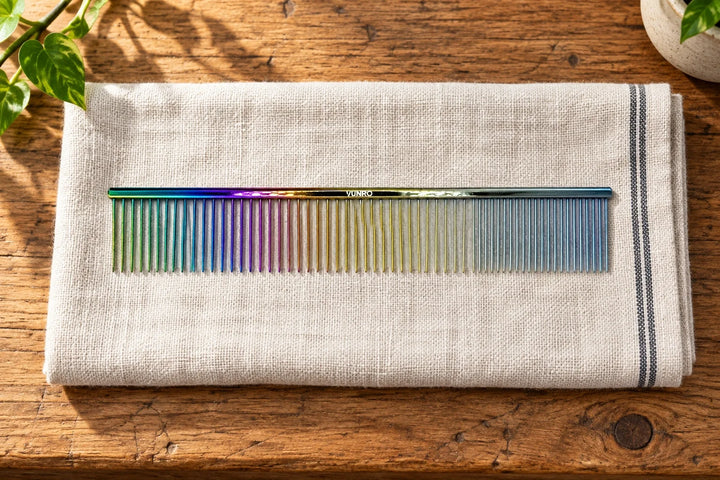
Which VUNRO Grooming Comb Fits Your Work?
Read the guide →


